Who wins,who loses?

Exclusive, is a phrase being used more and more often within the gaming industry. The industry, as they would have us believe, is that making games exclusive to one console format is offering us (the consumer) more choice or an 'exclusive' right to play certain games. I'd argue the exact opposite! Exclusive; adjective, excluding or not admitting other things / restricted to a person, group, or area concerned. Exclusivity by definition means that by offering one person exclusivity, another will miss out, so how is this good news for the average gamer?
As a gamer, the options are Xbox One, PS4, Wii U or PC and with console exclusives (unless you have spent £2500 on all four), you're going to miss out. I understand the premise of offering exclusives but in a market that should be driven by choice, leading to healthy competition, excluding as much as half the consumer base by way of a single format exclusive, I feel to be nonsense.
The reasoning (I believe), behind exclusives is that consumers will choose to buy one console over the other based on the upcoming exclusives that's on offer, and according to Sony and Microsoft and various publishers, exclusives are a warranted and valid reason to sway your purchasing decision! I would argue that if the last two years in the industry has taught us, is that exclusives generally haven't lived up to the hype. Sony's The Order 1886 was too short and irritated just about everyone with its limited campaign and vague story line, while Microsoft's Masterchief collection had completely broken multiplayer and that's what everyone who bought the game was interested in, the nostalgia of playing blood gulch in HD graphics with servers better than what the original Xbox could offer.
I myself have both consoles and have for the most part been pretty disappointed with games and the industry as a whole. I've been gaming since the Super Nintendo Entertainment System and fondly remember the days of connecting two or three Xbox's together at a friends house in a way that brought people together, was a personilsed experience with nothing like it now a days. 10 year old's are on Call Of Duty, Asymmetric multiplayer games such as Evolve where a mic is absolutely necessary and no one uses one or FIFA's pro clubs drop in matches where everyone is out for themselves and try to score from 80 yards out!
As a faithful gamer all I want is my £50 pounds to be enough, I want the game to live up to the hype as promised, I don't want to be lied to or manipulated and left with a feeling of dissatisfaction after finishing a game or realisng it's so blatantly obvious content has been withheld and I've just dropped£50 on half a game!
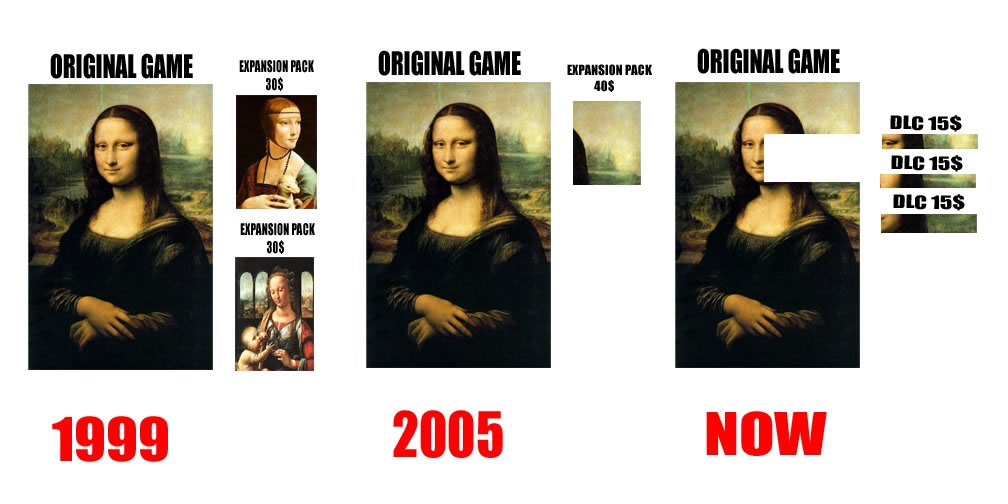
As supposed gamer's themselves, the developers of the games we play, do they not remember the days when you would unlock weapons, characters and skin models by just playing the damn game! I would like to know where their sense of pride is when they believe people should pay for, what use to be standard practice, and add value to the experience, but now demand £3.50, £4.99, £9.99, £19.99. £34.99 up to as high as £79.99 just to get the full experience?!
What is happening is worrying and again as long as people buy into their schemes these bad practices will themselves 'Evolve'.
The reasoning (I believe), behind exclusives is that consumers will choose to buy one console over the other based on the upcoming exclusives that's on offer, and according to Sony and Microsoft and various publishers, exclusives are a warranted and valid reason to sway your purchasing decision! I would argue that if the last two years in the industry has taught us, is that exclusives generally haven't lived up to the hype. Sony's The Order 1886 was too short and irritated just about everyone with its limited campaign and vague story line, while Microsoft's Masterchief collection had completely broken multiplayer and that's what everyone who bought the game was interested in, the nostalgia of playing blood gulch in HD graphics with servers better than what the original Xbox could offer.
I myself have both consoles and have for the most part been pretty disappointed with games and the industry as a whole. I've been gaming since the Super Nintendo Entertainment System and fondly remember the days of connecting two or three Xbox's together at a friends house in a way that brought people together, was a personilsed experience with nothing like it now a days. 10 year old's are on Call Of Duty, Asymmetric multiplayer games such as Evolve where a mic is absolutely necessary and no one uses one or FIFA's pro clubs drop in matches where everyone is out for themselves and try to score from 80 yards out!
As a faithful gamer all I want is my £50 pounds to be enough, I want the game to live up to the hype as promised, I don't want to be lied to or manipulated and left with a feeling of dissatisfaction after finishing a game or realisng it's so blatantly obvious content has been withheld and I've just dropped£50 on half a game!
As supposed gamer's themselves, the developers of the games we play, do they not remember the days when you would unlock weapons, characters and skin models by just playing the damn game! I would like to know where their sense of pride is when they believe people should pay for, what use to be standard practice, and add value to the experience, but now demand £3.50, £4.99, £9.99, £19.99. £34.99 up to as high as £79.99 just to get the full experience?!
What is happening is worrying and again as long as people buy into their schemes these bad practices will themselves 'Evolve'.